
UdhaarAI
Thirteen million Indian shops run on credit written in a paper notebook. Every app built to fix that asks the shopkeeper to stop writing and start typing. This one doesn't. He keeps the notebook. He photographs a page. The arithmetic disappears.
No sign-up. Real interface, sample shop.
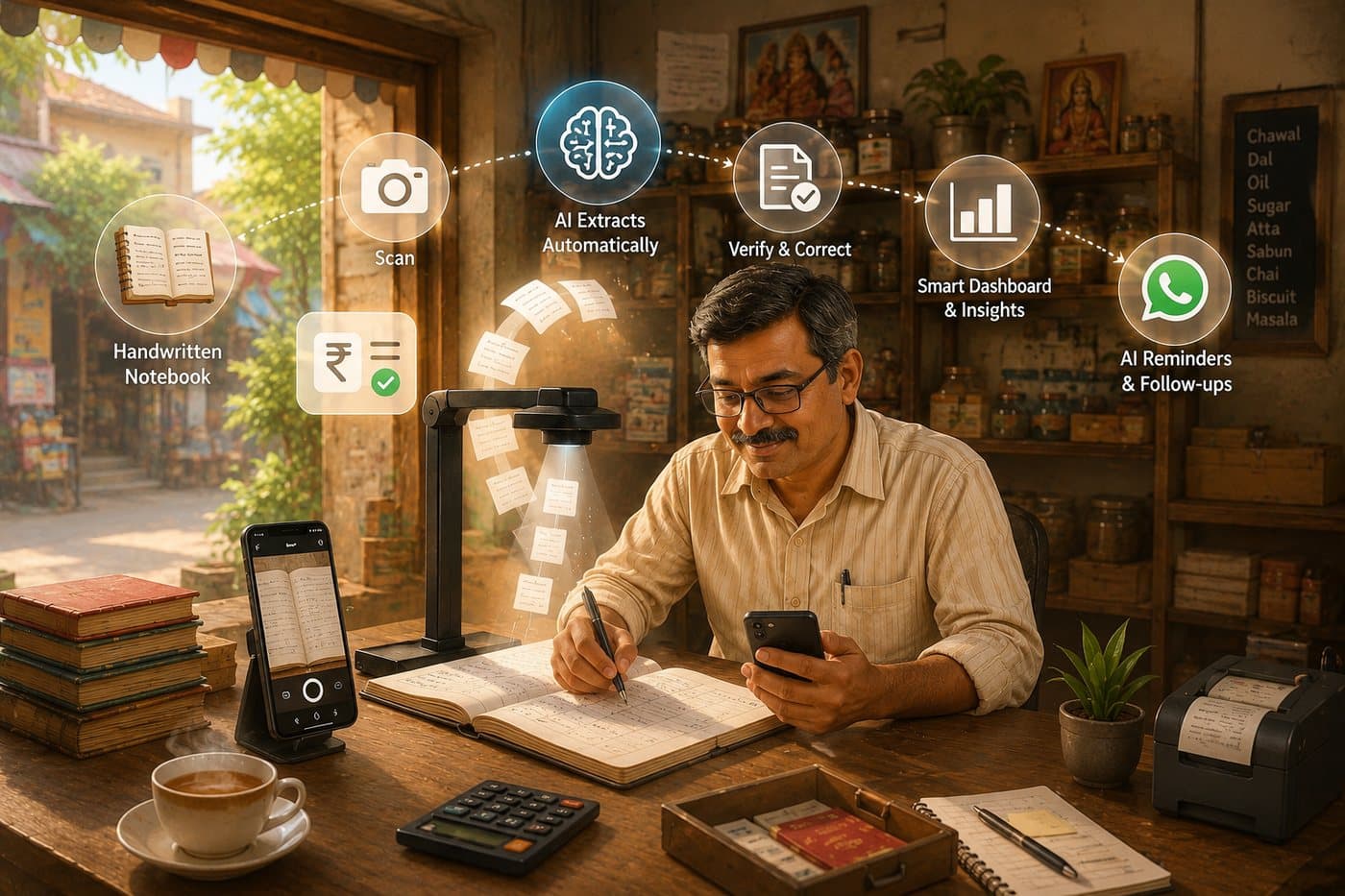
The notebook never leaves the counter. Everything downstream of it becomes automatic.
Ink smudged across the third digit · could read as 1350
A flagged wrong guess costs a second. A confident wrong guess costs the customer.
THE ACTUAL PROBLEM
Nobody wants to stop writing.
Every app pretends otherwise.
A customer phones in an order. The shopkeeper is holding the phone in one hand and a pen in the other, and he writes it in the book while they talk. That takes three seconds and needs no signal, no battery, no login, no reading.
Now picture the alternative. Unlock the phone. Find the app. Wait for it to load. Search for the customer. Tap through to add an entry. Type the amount. Save. All while somebody is still talking on the other end.
That is why the paper wins. Not because shopkeepers are behind the times — because for the thing they are actually doing, paper is genuinely faster. Many of them are not comfortable readers either, and a dense mobile interface is a wall.
So the paper stays. UdhaarAI meets it at the end of the day instead of trying to replace it at the start. One photo, and everything that was written by hand is searchable, totalled, backed up, and ready to chase.
How a day actually goes
The order matters — confirmation sits before the ledger, never after.
He writes it down anyway
A customer calls, he notes it in the book mid-conversation. No app open, no typing, no interruption. Nothing changes about how he works.
One photo at closing time
End of day, he photographs the page. Hindi, Telugu, English, all three mixed — the reader handles the page as written.
It shows him its doubts
Every field carries a confidence score. Smudged amounts come back amber, not silently banked at 95%.
The ledger keeps itself
Balances, ageing, who has gone quiet for four months. Updated the moment he confirms the page.
WHAT CHANGES
Nothing about how he works.
Everything about what it costs him.
- Type in every entry by handPhotograph the page you already wrote
- Flick through the notebook to find a nameSearch any customer instantly
- Add it up on a calculatorBalances total themselves
- Work out who to chase from memoryA collection list, ordered, with reasons
- Write each reminder yourselfReminders drafted in Telugu, Hindi or English
- Hope the notebook survives the monsoonBacked up the moment you confirm a page
- Hand-write a receipt, or skip itA proper PDF receipt with your shop's logo
WHERE IT SITS
Between two things that already exist
Khatabook and OkCredit are good products with millions of users — but every entry is typed by hand. Dukaan AI removes the typing with voice, and its AI scanner reads printed purchase bills, not a handwritten khata page. Transkribus and Pen to Print read handwriting beautifully — and hand back text, not a ledger. Each solves a piece. None starts from the page already written.
| UdhaarAI | Khatabook / OkCredit | Dukaan AI | Handwriting OCR tools | |
|---|---|---|---|---|
| Starts from your handwritten page | printed bills only | |||
| No typing or dictating to add an entry | ||||
| Understands customers and running balances | ||||
| Shows a confidence score per field | not stated | not stated | partly | |
| Merges misspelled customer names | ||||
| Hindi and Telugu handwriting | not stated | not stated | partly | |
| WhatsApp reminders in local languages | ||||
| Collection priority with stated reasons |
Compared on each product's own public description, July 2026. Only apps we could verify are listed. These are all good products and all better than paper — the claim here is narrow: none of them begin with the page you already wrote by hand.
What is actually built
Every one of these is in the demo. Nothing on this page is a mockup of a plan.
Reads the page, not just the text
Knows a row is a customer, a credit and a payment — not a paragraph. That is the difference between a scanner and a ledger.
Tells you who to chase, with reasons
A risk score built from age, repayment history and exposure. Every number shows its working. No model is asked to decide.
Reminders in three languages
English, Hindi, Telugu. Four tones. Editable before it goes anywhere near WhatsApp.
Ask it plainly
“Who hasn't paid in sixty days?” Answered only from your own entries.
Only you can read it
Row Level Security on all seven tables. Photos in a private bucket behind one-hour signed links. 82 automated tests.
Yours to take
Full CSV export any time. No lock-in, no subscription wall on your own data.
UNDER IT
The model is checked, not trusted
Gemini reads the page. Everything after that is deterministic code that can be tested, and is. If the model reports 95% confidence on a nine-digit phone number, the structural check overrules it.
Indic numerals
Devanagari and Telugu digits rewritten before any arithmetic. Pure lookup.
Name matching
Jaro-Winkler plus a phonetic key. “Yadhav” merges into “Yadav”; “Suresh Yadav” does not.
Arithmetic audit
Running balances reconciled across rows. Catches dropped zeros the model cannot know it dropped.
Risk scoring
Pure TypeScript with stated reasons. No model is asked who to chase.
THE FLAGSHIP
It doesn't wait to be asked
Most tools answer questions. UdhaarAI watches the ledger and tells you what needs attention — who to collect from, where money is leaking, when a festival is about to stretch your credit. Every line is computed from your own numbers, with the reason shown.
Your advisor is watching the numbers
Proactive advice, not just answers to questions
Collect from Ravi this week — ₹8,500 outstanding, and he usually pays on time.
Your grocery expenses are up 18% on last month. Worth checking where the extra ₹4,200 went.
You're giving credit faster than collecting it. Consider reminders for the 5 customers still carrying a balance.
Diwali is around 12 days away. Collect pending balances before customers ask for festival credit.
More than a notebook scanner
Reading the page is where it starts, not where it stops.
Understands handwritten notebooks
Hindi, Telugu and English on the same faded page.
Checks itself before saving
Every field scored; anything uncertain waits for you.
Manages customers intelligently
Merges misspelled names, scores who repays reliably.
Tracks income, expenses and profit
Not just who owes what — what the shop actually keeps.
Reads the business, not just the page
Health score, ageing, collection priority, all explained.
Advises, in your language
Proactive, plain advice through text or voice in three languages.
Don't take the claim. Click it.
The demo is the real interface with a sample shop loaded. Review a page, watch the flagged field, see who it says to chase and why.